

whitedolphin.ca@gmail.com
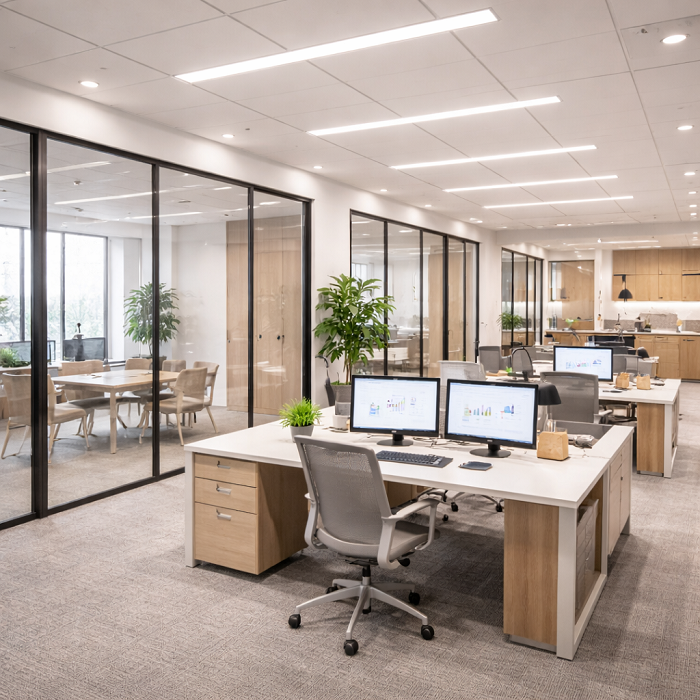
Office Renovation Cost Guide 2026 helps GTA businesses plan renovation budgets with clarity—covering real per-square-foot costs, compliance requirements, and financial strategies tailored to Toronto’s commercial market.
- Define your scope and cost drivers upfront by distinguishing between “must-have” upgrades (like compliance or HVAC) and optional enhancements, ensuring each dollar aligns with business goals.
- Benchmark your project budget using the latest GTA per square foot ranges—from $20–$50/sq. ft. for light refreshes to $200–$660+/sq. ft. for full fit-outs with high-end amenities.
- Account for professional and regulatory fees—expect architect, designer, and contractor costs to claim 20–25% of total spend, and set aside $380–$1,900+ for required permits and inspections.
- Prioritize compliance, safety, and sustainability to avoid surprise costs and future penalties; invest in energy-efficient systems or low-VOC materials for long-term savings and improved retention.
- Monitor and manage costs proactively with digital tracking tools, milestone-based payments, and frequent progress reviews, minimizing financial surprises through every phase.
- Build in a 10–20% contingency reserve to cover hidden conditions or scope changes—especially in complex downtown or specialty projects where regulatory demands can escalate quickly.
- Collaborate with experienced, local design-build partners from day one for market-accurate estimates, efficient procurement, and streamlined regulatory approvals in the GTA.
- Post-renovation, invest in ongoing facility reviews and smart technologies to track performance, maximize ROI, and adapt your workspace as business needs evolve.
Implementing these strategies ensures your office renovation budget delivers long-term value, compliance, and operational performance. For a deeper dive into costs, best practices, and GTA-specific trends, explore the full guide.
Office Renovation Cost Guide 2026: Scope, Compliance, and Cost Drivers
For many GTA businesses, the reality of office renovation costs often lands later—and higher—than expected. A single change order can shift a $200,000 budget by 10–20% overnight, leaving even seasoned teams recalibrating mid-project.
Yet the stakes have never been greater. With evolving building codes, growing demand for hybrid-ready layouts, and strict compliance standards, today’s workplaces must do more than just look modern—they have to deliver ongoing performance, flexibility, and regulatory assurance.
You’re not just managing a line item; you’re making a lasting investment in how your business operates and what it communicates to staff, clients, and investors.
This guide equips you to:
- Pinpoint true project scope—from light refresh to complex fit-out
- Benchmark reliable costs per square foot
- Identify major cost drivers and compliance requirements unique to the GTA
- Structure a renovation budget that anticipates both known and hidden expenses
Armed with clear benchmarks and an understanding of major cost factors—from site logistics to sustainable material selection—you’ll gain the clarity necessary to keep your renovation on schedule, within budget, and 100% compliant.
Why now? Labor shortages, regulatory updates, and new technology expectations have redefined the competitive landscape. The best-prepared businesses aren’t just focused on price—they’re engineering a process built for long-term value, risk management, and exceptional space performance.
As you plan your 2026 office renovation, getting the numbers right from the outset is both your strongest tool and your best defense. What separates a resilient project from a risky one? It all begins with understanding purpose, scope, and the real-world drivers that shape every dollar spent.
Explore the first critical steps—what defines today’s office renovations, key influences on your budget, and why a disciplined approach has never been more important.
Understanding Office Renovation in 2026: Purpose, Scope, and Cost Drivers
Renovating an office in 2026 means far more than new paint or flooring—it’s about transforming workspaces to match evolving demands and regulations.
Whether your goal is a light refresh or a full-scale fit-out, understanding project scope is your first step to building an effective budget.
Office Renovation Defined: From Cosmetic to Comprehensive
Picture this: a small professional clinic needs only updated flooring and wall finishes, while a downtown Toronto tech firm may require a complete systems overhaul—including HVAC, open-plan space planning, and integrated smart technologies.
Typical office renovations range across three scopes:
- Cosmetic Refresh: Paint, new flooring, lighting updates
- Mid-Level Upgrade: Partition reconfigurations, targeted HVAC/electrical, branding touches
- Full Fit-Out: Structural modifications, full MEP (mechanical, electrical, plumbing) integration, specialty amenities
Key Business Drivers Shaping Renovation Priorities
Businesses in the GTA invest in workplace renovations to:
- Modernize outdated layouts for hybrid teams
- Achieve code compliance—from accessibility to emissions (critical as building codes evolve yearly)
- Support branding objectives through bespoke interior finishes and signage
- Maximize space efficiency to accommodate growth or optimize tenancy
A single renovation can transform how a company operates, feels, and is perceived both by staff and clients.
Primary Cost Drivers: What Shapes Your 2026 Budget
Three core factors heavily influence renovation budgets:
- Project Scale/Complexity: Larger, more intricate renovations amplify costs and timelines.
- Material & Finish Selection: Choices from sustainable flooring (at $2–$15/sq. ft.) to premium glass partitions ($180+/sq. ft.) drive budgets up or down.
- MEP Requirements: Upgrades for HVAC, plumbing, and fire safety (e.g., sprinklers at $5,000–$10,000) represent a significant expense.
Location matters—the GTA often tracks just below New York City fit-out costs (NYC’s 2026 average: $212.59/sq. ft. for construction-only), but ahead of national Canadian averages due to local labor and compliance premiums.
Compliance, Sustainability, and Regulatory Complexity
Today’s renovations are measured by more than aesthetics; GTA businesses must address:
- Sustainability benchmarks (energy-efficient lighting, low-VOC materials)
- Stringent permitting and inspections (fees from $380–$1,900+ per project)
- Building code compliance in fire safety, accessibility, and emissions
Every detail must meet current regulations—failure adds time and surprise expenses.
—
A disciplined approach to office renovation in 2026 starts with understanding your true scope and primary cost drivers. Prioritize compliance and long-term flexibility to ensure every dollar spent delivers lasting value—a process built for busy businesses aiming for seamless, safe, and future-ready workplaces.
Office Renovation Costs: 2026 Benchmarks, Trends, and Key Variables
Per Square Foot Cost Ranges
For office renovation projects in 2026, cost per square foot is the primary budgeting metric.
Most projects in the GTA fall into these benchmark categories:
- Light Refresh: $20–$50/sq. ft. — covers paint, flooring, and minor finishes.
- Basic/Mid-Range Renovation: $50–$150+/sq. ft. — includes partitioning, targeted electrical and HVAC, plus layout changes.
- Full Fit-Out (Construction Only): $200–$300+/sq. ft.; compare with the NYC benchmark of $212.59/sq. ft. for fit-outs of a similar scale.
- High-Spec Fit-Outs: $300–$660+/sq. ft. — adds premium AV, sustainability features, and custom elements.
GTA businesses typically budget above national averages, reflecting Toronto’s skilled labor market and regulatory standards.
“Budget with intent: A 1,000 sq. ft. mid-range renovation ranges from $50,000 to $150,000, while a premium fit-out begins north of $300,000.”
Picture this: walking through a sleek, modern office with glass partitions and smart lighting—this transformation lands firmly in the $200+/sq. ft. bracket.
Critical Cost Variables and Market Trends
Why are costs rising? Several key factors drive current office renovation budgets:
- Labor and Skilled Trades: High demand and limited availability contribute to persistent upward pressure on rates.
- Material Costs & Supply Chain: Volatility in global shipping, as well as adoption of eco-friendly materials, add unpredictability and sometimes a premium.
- Project Timelines: Accelerated schedules or after-hours work can escalate total cost by 10–20%.
- Regulatory Changes: Implementation of new safety codes, fire/emission standards, and accessibility mandates in Ontario directly affect MEP and compliance costs.
For GTA offices, location also matters:
- Downtown high-rises face stricter logistics, limited access hours, and increased permit/inspection fees.
- Suburban or multi-tenant sites may offer more flexible staging but must navigate shared system upgrades.
“Even a modest change in scope—additional IT, upgraded HVAC, or LEED certification—can move a project into a new cost tier.”
What Drives Value Now
These 2026 trends are shaping renovation ROI:
- Demand for collaborative workspaces and hybrid-ready layouts.
- Integration of building automation and advanced security.
- Emphasis on durability and lifecycle cost reduction: investing in compliant, energy-efficient systems pays dividends in lower operating expenses.
Proactive, disciplined planning—grounded in realistic benchmarks and a detailed understanding of current market variables—is the surest way to protect your investment and support long-term business goals.
“Today’s office renovation is more than an expense; it’s a strategic investment in performance, compliance, and future-ready value.”
Itemized Office Renovation Expense Breakdown
Major Budget Categories
A precise understanding of where your renovation dollars go is mission-critical for effective commercial budgeting in 2026.
Expect architect, designer, and contractor fees to account for 20–25% of the total project cost—this covers early design, regulatory documentation, and construction management.
The backbone of any renovation—construction trades—includes demolition, framing, drywall, and painting. Costs can vary dramatically with scale and finish level.
Flooring materials and installation come next:
- Carpet tile, vinyl, or basic finishes: $2–$7/sq. ft.
- Hardwood, bamboo, or high-sustainability options: $7–$15+/sq. ft.
Walls and partitions span a wide spectrum:
- Standard or modular systems: $12–$40/sq. ft.
- High-end glass installations: $100–$180+/sq. ft.
Electrical, lighting, and AV infrastructure—think lighting fixtures, smart controls, and meeting room A/V—typically ranges $150–$300+ per unit/fixture.
MEP upgrades (HVAC, plumbing, fire safety) are a must in modern offices. Example: Add sprinkler installation at $5,000–$10,000 to the budget baseline.
Amenities like kitchens, breakrooms, and washrooms create team-ready workspaces:
- Kitchens/breakrooms: $6,000–$31,200
- Washrooms: $18,000–$24,200+ (add $6,000–$8,400 for showers)
“Every dollar invested in durable fixtures and professional services safeguards long-term space performance.”
Ancillary and Hidden Costs
Failing to account for permits and inspections can disrupt both budget and schedule. Set aside $380–$1,900+ per project.
Technology upgrades matter for security and connectivity—IT cabling and security equipment typically range $100–$3,000+ per unit.
Plan for often-overlooked items such as:
- Site logistics and scheduling (including after-hours work)
- Waste disposal during and after the renovation
Allocate a contingency reserve of 10–20%; unexpected requirements are the norm, not the exception.
“Your project’s success is defined by the costs you anticipate—and those you don’t.”
Sustainability and Long-Term Performance
Investing in energy-efficient lighting, low-VOC materials, and smart building controls may increase upfront costs.
However, these choices lower maintenance and future operating expenses, aligning your renovation with both sustainability trends and evolving regulatory mandates.
Lifecycle cost analysis is now an expectation, not an option, for businesses focused on long-term value and compliance.
Picture a scenario: A GTA firm opts for sustainable carpet squares and LED lighting—incurring a 5–15% higher initial outlay, but seeing annual utility savings of $0.75–$1.25/sq. ft. and improved air quality for staff retention.
“Future-ready renovations prioritize both performance and responsibility.”
A comprehensive renovation budget is built on clear categories, allowance for surprises, and investment in resilient design. By structuring your costs strategically, you lay the groundwork for spaces that support your business today—and adapt as you evolve.
Budget Planning: Steps and Best Practices for Accurate Office Renovation Financials
Scoping and Needs Assessment
Before budgeting, clearly define essential scope elements—what your business must have to operate and reflect your brand.
List “must-haves” (such as new partitions or upgraded MEP) separately from “nice-to-haves” (designer lighting, premium finishes).
Prioritize those elements that directly support operational efficiency, compliance, and long-term branding goals.
Picture this: A financial firm needs secure IT rooms (essential) but may wish for a client lounge (discretionary).
Actionable takeaway: Outlining these distinctions early avoids surprise scope creep and keeps costs predictable.
Estimating and Allocating the Budget
Begin with the basics—multiply office area by the latest per square foot benchmarks: $50–$150+ for mid-range, $200–$300+ for full fit-outs in the GTA.
Integrate key line items:
- Professional fees (20–25% of total)
- Flooring, partitions, MEP upgrades
- Amenities and technology
- 10–20% contingency for unforeseen issues
Allocate funding toward long-term advantages, such as energy-efficient lighting or low-VOC materials.
Bold insight: “Your upfront investment in quality can lower operating costs for years to come.”
Professional Guidance and Competitive Bidding
Engage an experienced design-build partner early to harness market-accurate cost projections.
Develop a detailed, documented scope of work; this is the blueprint for competitive bids from reputable contractors.
Structure payments on milestone completion, ensuring clear, transparent financial progress.
Quotable tip: “Transparent documentation and milestone-based payments are your best safeguard against budget drift.”
Monitoring and Managing Costs Throughout the Project
Monitor costs relentlessly.
Adopt these controls:
- Frequent progress reviews with your contractor
- Swift management of change orders
- Use digital cost tracking tools for real-time reporting and forecasting
A disciplined project manager will act as your partner in controlling both budget and timeline—think of them as your renovation’s financial pilot.
Final tip: “A well-structured budget isn’t just a number—it’s your roadmap to a high-performance, future-ready office.”
Effective office renovation budget planning in 2026 means precise scope definition, data-driven estimates, contingency reserves, and active, transparent management—laying a financial foundation as resilient as the spaces ODIMA builds.
Comparative Costs: Renovation vs. Refurbishment Across Office Types and Sizes
Different Space Types
Office renovation costs in 2026 vary widely by space type and project goals.
Small offices can often achieve targeted updates at the lower end of the scale, while large corporate environments or specialty spaces command higher investment due to complexity and compliance needs.
- Small offices (under 5,000 sq. ft.): Expect costs at $20–$75/sq. ft. for refreshes; full upgrades start at $100/sq. ft.
- Midsize tenant suites (5,000–20,000 sq. ft.): Ranges commonly fall between $50–$150+/sq. ft. depending on scope.
- Large corporate floors (20,000+ sq. ft.): Benchmark $100–$300+/sq. ft. for major renovations or fit-outs.
- Specialty spaces (medical, industrial, studios): Frequently exceed $200–$660+/sq. ft. due to regulatory and technical demands.
The choice of finishes, building system enhancements, and local compliance standards are the biggest cost drivers, especially in the GTA’s dense commercial market.
—
Comparative Analysis
Evaluating renovation (modernizing existing space) versus new build-out (constructing from raw shell) reveals distinct advantages for each, depending on business priorities.
- Renovation: Generally more cost-efficient ($20–$150+/sq. ft.) and faster when existing layout supports needs; best for occupied, legacy, or value-focused properties.
- New build-out: Delivers maximum customization but at premium costs ($200–$300+/sq. ft.), along with longer timelines—considered when structural changes or comprehensive rebranding are needed.
Within the GTA, downtown spaces face added permit, logistics, and heritage protection costs, while suburban offices may benefit from easier access and more flexible infrastructure.
Picture this: A mid-rise heritage building in Toronto’s downtown core may see total project costs increase by 15–25% versus a similar project in a suburban business park, simply due to permit, access, and integration requirements.
—
Real-World Case Studies and Benchmarks
Recent ODIMA-led office projects in the GTA illustrate the range of possible outcomes:
- Technology suite renovation (12,000 sq. ft., Mississauga): $100–$175/sq. ft.; six-month delivery; primary cost drivers: AV upgrades, energy-efficient lighting.
- Downtown financial tenant fit-out (7,000 sq. ft.): $180–$240/sq. ft.; specialty fire systems, high-end glass partitions, tight four-month timeline.
- Medical clinic expansion: Exceeded $300/sq. ft.; significant MEP upgrades, accessibility, and compliance requirements.
Key lessons: Projects with complex building systems or regulatory constraints demand higher contingency (up to 20%), while efficient planning and clear scoping reduce overruns.
—
To set a realistic renovation budget, assess your office type, target scope, and regulatory demands early. The most cost-effective projects align space needs, compliance, and desired value from day one—building long-term business performance into every square foot.
Market Trends and Innovations Impacting 2026 Office Renovation Costs
Design and Technology Integration
Modern offices in 2026 are defined by hybrid-ready workspaces, advanced AV, and wellness-driven design.
Collaboration spaces and flexible layouts are no longer optional—they’re considered baseline in the GTA’s most competitive businesses.
Picture this: touchless entry systems, sound-dampened focus pods, and video-enabled meeting rooms—features that drive office fit-out costs as high as $300–$660+ per sq. ft. for high-spec environments.
Upgrading IT, AV, and security is now a core project component.
- Cloud-first infrastructure, building automation, and sophisticated access control are becoming industry standard
- Integrated, adaptable lighting and environmental controls support both employee wellbeing and efficiency
“In 2026, the office isn’t just where work happens—it’s the technology ecosystem clients and teams expect.”
Sustainability, Compliance, and Future-Proofing
The demand for energy efficiency and green building standards directly shapes budgets.
GTA projects increasingly address new code requirements—health, fire, accessibility, and emissions—that can add 5-15%+ to baseline costs but are non-negotiable for long-term compliance.
- High-performance glazing, low-VOC paints, and LED lighting deliver immediate and ongoing payback
- Smart HVAC and occupancy-sensor controls help reduce utility bills and cut carbon footprints
A single compliance penalty (such as NYC’s $268 per emissions exceedance unit) can rapidly outweigh upfront investments.
“Sustainable upgrades are no longer aspirational—they’re required for long-term value.”
Managing Risks and Maximizing Value
Discipline, planning, and quality contractor selection are essential to avoid costly surprises and build resilient workspaces.
A sound, structured process—from transparent procurement to milestone-based payments—reduces risk and drives project certainty.
To maximize ROI and manage costs:
- Vet every material and subcontractor for durability and warranty coverage
- Use digital cost-tracking tools for real-time oversight
- Allocate a 10–20% contingency for hidden conditions
“Precision in planning is the most reliable strategy for safeguarding your investment.”
A successful 2026 office renovation in the GTA achieves more than a new look—it’s about integrating technology, meeting evolving codes, and investing in durability. The most effective budgets prioritize compliance and adaptability from day one, ensuring every dollar supports long-term business performance.
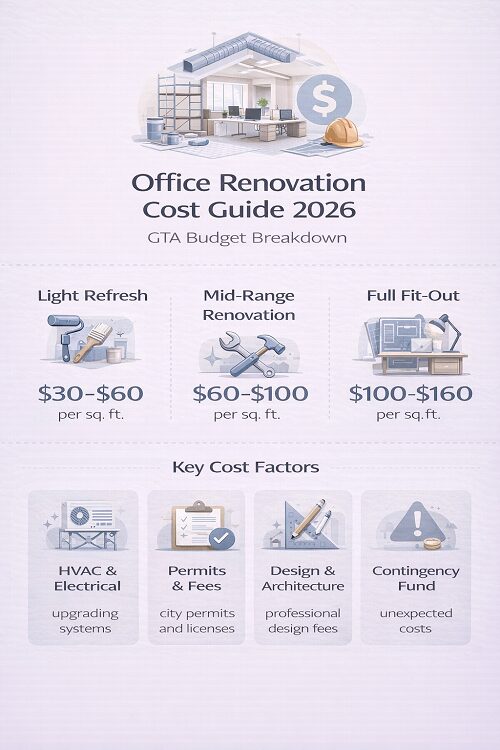
Strategic Framework: Setting and Managing an Effective 2026 Office Renovation Budget
Step-by-Step Budgeting Methodology
A methodical approach protects your investment and reduces surprises throughout the office renovation process.
Begin by clearly defining your project scope:
- Separate must-have upgrades (e.g., code compliance, layout changes) from “nice-to-haves” (e.g., aesthetic enhancements, premium finishes)
- Map out operational and branding priorities before procurement begins
“A clearly defined scope is the foundation for cost control—every dollar should be traceable back to a business goal.”
Create your initial budget by multiplying total square footage by the relevant 2026 cost range (e.g., $50–$150+ per sq. ft. for mid-range; $200–$660+ for full fit-outs).
Don’t forget to:
- Itemize line costs: professional fees, trades, materials, permits
- Allocate a 10–20% contingency to safeguard against unknowns
—
Best Practices: Estimation, Procurement, and Cost Tracking
Rigorous estimation and procurement strategies are essential to maintain accountability and deliver value.
Leverage these best practices:
- Solicit detailed quotes from multiple design-build firms, ensuring specifications cover compliance, safety, and timeline expectations
- Develop milestone-based contracts with clear deliverables and payment schedules
- Utilize digital project management tools to monitor spend in real time and flag variances
“Transparent tracking and disciplined procurement enable rapid response if your renovation costs shift unexpectedly.”
Picture this: You review your weekly cost dashboard; a variance in electrical spend triggers a team meeting—corrections are made quickly, keeping the budget on track.
—
The Power of Collaboration, Transparency, and Expert Guidance
Engage with an experienced partner early—consulting a local design-build expert leads to more reliable estimates and streamlined permitting in the GTA.
- Collaborate with your contractor and architect at each key milestone
- Hold scheduled progress reviews to validate spend and scope against goals
“Effective office renovations are built on clear communication and specialist insight at every step.”
—
Post-Renovation Evaluation and Continuous Facility Improvement
A disciplined office renovation budget doesn’t end at project handoff.
Set up ongoing facility assessments:
- Schedule post-completion walk-throughs and regular operations reviews
- Invest in smart building technologies to track efficiency and reduce future costs
“Renovation success is measured not just by build quality, but by long-term space performance and adaptability.”
—
A structured budgeting framework—emphasizing scope clarity, real-time cost tracking, and professional guidance—gives Toronto businesses full visibility, control, and confidence as they navigate the complexities of a 2026 office renovation.
Custom office cabinet solutions designed to maximize workspace efficiency, improve storage organization, and complement modern office layouts.
Conclusion
An office renovation in 2026 is more than an expense—it’s a strategic move that drives performance, meets compliance, and supports your business’s long-term success. By approaching your project with discipline, clarity, and trusted guidance, you transform uncertainty into confident progress.
Key Takeaways for a Future-Ready Office Renovation:
- Define your true project scope upfront—distinguish essentials from “nice-to-haves” to protect your budget and timeline.
- Use current GTA cost benchmarks to build a realistic financial plan that anticipates material, labor, and regulatory variables.
- Prioritize compliance and sustainability—these are not optional; they safeguard your investment against hidden risks.
- Engage an expert design-build partner early to ensure transparent procurement and accurate, milestone-driven management.
- Monitor costs and project progress relentlessly using digital tools for full visibility and rapid response.
Next Steps:
- Schedule a detailed needs assessment with stakeholders to clarify business goals and operational priorities.
- Request itemized quotes from reputable local contractors, ensuring all compliance, safety, and schedule requirements are reflected.
- Allocate a 10–20% contingency fund from the outset—building flexibility into your plan is essential for success.
- Establish milestone-based contracts and regular cost reviews to keep progress transparent and controlled.
- Plan for post-renovation evaluations to track performance and unlock ongoing efficiencies.
Every decision you make now shapes the workspace and reputation you’ll own tomorrow. Take command of your renovation—structure your investment with intent, insist on compliance, and partner for performance.
Your office is more than a place to work—it’s a foundation for your brand and your team’s success. Build it with confidence. The most valuable square footage is the one you planned for next.
learn more about our design-build expertise.
FAQ
What is the average office renovation cost in 2026? According to the Office Renovation Cost Guide 2026, GTA projects range from $20–$50 per sq. ft. for light refreshes and up to $660+ per sq. ft. for high-spec fit-outs.
How accurate are per-square-foot renovation estimates? They provide a strong starting point, but final costs depend on compliance, building condition, and material selection.
Does the Office Renovation Cost Guide 2026 include permit and compliance fees? Yes. It accounts for architectural fees, inspections, and Ontario building code requirements.
How much contingency should I budget for an office renovation? Most experts recommend 10–20% contingency, especially for downtown Toronto projects.